Talking Statues, Rome’s Secret Gossipers
by Sydney Gordon
Once upon a time in distant 15th century Rome, there lived a poor tailor by the name of Pasquino. He joyfully entertained his fellow neighbors with myriads of witty jests, always sporting a hearty smile and sparkling eyes. The lively Pasquino made sure to complete every joke with colorful facial expressions, from painfully miserable to comically exuberant. Eventually he passed on, leaving his friends to miss his clever banter. Some years after his death, an ancient marble statue of a hero rescuing a dying soldier was unearthed near the tailor’s old home. Cardinal Oliviero Carafa took a liking to the worn statue, and had it placed in a small square near the Piazza Navona in 1501. The Cardinal began sponsoring a literary competition every April 25th, in which contestants placed poems on the statue. Soon people began hanging poetry on the statue’s neck on other days throughout the year, which morphed into jokes about their fellow villagers. These gossips boldly became satires against the papal government, making them the first political mockery in Rome. Seeking to honor their beloved lampooning tailor, people dubbed this sardonic statue “Pasquino,” memorializing the jokester in marble.
But who actually was this mysterious and ruined statue? The sculpture dates back to the Hellenistic Period, around 250-200 BC. The Hellenistic period began with the death of Alexander the Great in 323 BC, when his sudden decease left his Greek empire without an heir. Several of his top generals fought amongst themselves to divide his colossal realm, eventually culminating in the creation of three major Macedonian kingdoms. During this transitory period between the decline of classical Greece and the gradual rise of the Roman Empire in second century BC, Hellenistic society grew increasingly urbane and socially complex. Given the stability of the new kingdoms at the start of this period, the elite were able to focus on strengthening their cultural status via literature, science, and of course, art. Kings mainly commissioned statues for display in public, and sculptors began deviating away from the formal restrictiveness of Classical art. Rather than being rigid and unexpressive, Hellenistic sculpture features a great variety of subjects, from drunken old women to voluptuous Aphrodites, characterized by idealistic and overly dramatized body parts and facial expressions.
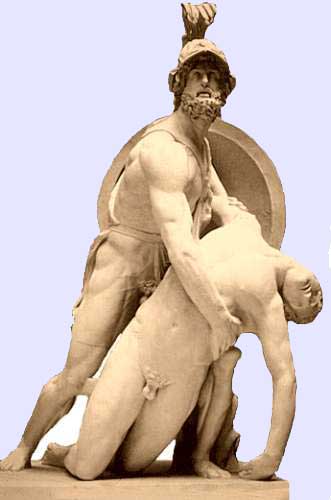
The Hellenistic statue known as Pasquino by modern Romans is speculated to have once decorated a public stadium. Although Bernini believed the figures to represent Alexander the Great being rescued by a soldier, and even considered the worn sculpture one of the finest pieces of ancient Rome, it is now widely accepted that they are actually figures from Homer’s Iliad. In the depicted episode from the Iliad, the young soldier Patroklos dives into battle to fight for Achilles, is killed and stripped nude by Hektor, and then his body is rescued by the elder hero Menelaus. Despite the battered appearance of the original sculpture, three copies of Pasquino exist, which allowed the artist B. Schweitzer to create a beautifully detailed reconstruction. Today three copies exist, located in the Loggia dei Lanzi, the Palazzo Pitti, and the Palazzo Braschi. The accuracy of these copies enable analysis of the work’s key features.

http://www.mlahanas.de/Greeks/Arts/Polyphemos/MenelaosPatroklos.jpg
Typical of Hellenistic sculpture, the viewer can distinguish the epic Homeric figures based on subtle physical details. The rescuer sports enormous muscles while the dead soldier is smaller and not as defined. More importantly, the two men differ in hairstyles and dress. The beard and long hair of the rescuer indicate his senior status, in contrast with the short hair and beardless face of the dead soldier. Shorter hair symbolized a lesser rank in the time of the Iliad, so the viewer would have known instantly that the dead man is young and does not hold a high position. Thus, Bernini’s conjecture that the rescued man is Alexander, who obviously held a rank of utmost importance, is incorrect. Moreover, the dress of the two figures offers evidence as to their identities. The elder hero is fully outfitted with a tunic, shield, and helmet, whereas the dead youth is strikingly naked. Those who knew the Iliad would realize that these conspicuous differences between the two soldiers were clearly an illustration of the Homeric episode of Menelaus recovering the body of Patroklos. Besides, Menelaus’ large round shield frames the figures in an eye-catching pyramidal form, with Menelaus’ helmeted head forming the peak of the pyramid. The two bodies twist in opposing directions, with Patroklos’ limp head dangling to the side and Menelaus gazing off intensely into the distance. Such a carefully constructed and powerful formation leads the viewer to grasp that the elder hero must be part of an epic rescue.

http://upload.wikimedia.org/wikipedia/commons/1/1c/Pasquino_1.JPG
Although most of what remains of the original sculpture is the worn torso of Menelaus and a small portion of Patroklos’ chest, the Pasquino has remained a stealthy vehicle of satire for centuries. It rests in a corner of the Piazza di Pasquino, a square named for obvious reasons. The clever rhymes posted on Pasquino even inspired the creation of the word “pasquinade,” defined as “a brief and generally anonymous satirical comment in prose or verse that ridicules a contemporary leader or national event.” Despite papal laws that banned protest as heretic, crafty rebels continued inventing anti-papal satires that worried the papacy to the point that Pope Adrianus VI (1522-1523) resolved himself to silence the statue. Adrianus put the gossiping marble under nightly surveillance and threatened to throw the statue into the Tiber River, but his exertions failed. To the papacy’s dismay, the people added another sculpture to the world of wit: the gargantuan fountain Marforio.

http://www.romaspqr.it/roma/Statue/St.%20marforio.htm
Unearthed in Rome in the late 12th century, the giant Marforio dates back to the first century AD. People originally speculated that the fountain represented Jupiter or Neptune, or an emperor. Since the identity of the sculptor had been lost to antiquity, the truth remained a mystery for several hundred years. Then Andrea Fulvio, a Renaissance humanist, antiquarian, and adviser to Raphael, published his Antiquitates Urbis in 1527. In this guide to ancient artifacts in Rome, Fulvio declared the fountain to be a river god. Although it is still debated how Marforio received his name, many believe that his title derived from his old resting place in the Martis Forum, or Augustus’ Forum of Mars. The water god reclines behind a lion’s head, flanked by two small, barely noticeable dolphins that accentuate his great size. He relaxes with exposed torso, a sinuous robe draping over his legs and one arm, and as the author Mrs. Charles Macveagh enthuses,
“To make the hair and beard merge into the god’s breast and shoulders would have been simple both in conception and execution, but only a genius could have secured to the massive and supine figure that appearance of being outstretched in powerful yet melting length.”
This striking river god became the second talking statue, allowing Pasquino and Marforio to have little conversations. Ignoring all attempts by the pope to silence their political protests, people hung questions from Marforio, to which Pasquino would respond wittily. As early as 1509, the educated bookseller Giacomo Mazzocchi began gathering and distributing these satires, eventually publishing his complete collection in 1544 under the title “Pasquillorum, Tomi Duo.” Although published in Basel, a city less dominated by the papacy than Rome, the papacy still managed to suppress most copies of the book, making it a rare and valuable acquisition.
One of the many leaders mocked is Pope Leo X (1513-1521). A man of luxurious tastes, he resorted to selling off anything from cardinals’ hats to statues of Apostles to help pay for his overspending. The lucky Leo received numerous epitaphs in his honor, like the following:
Marforio:“Do you ask why Leo did not take the sacrament on his deathbed?”
Pasquino: “How could he-he had sold it!”
Pope Paul III (1534-1549) of the Farnese family was another scathingly ridiculed pope. Like many popes, he blatantly practiced nepotism, so evidenced in his elevation of two Farnese youths to cardinal positions, one of whom was Pier Luigi. The unpopular Pier had a reputation for rudeness and sodomy, so one clever pasquinade likened his image to Michelangelo’s Last Judgement, which features an unlucky man with a snake biting his sensitive area.
“Bound in Hell,
With a snake that bites him in the prick,
For the sin of breaking arses.
For this, in eternity,
Christ condemns the buggerers to the fire,
And to stand with a serpent in this sad place.”
To Pope Sixtus V’s (1585-1590) embarrassment, another conversation between Pasquino and Marforio goes,
Marforio: “You look very vulgar, Pasquino, why do you appear in the street with a dirty shirt?”
Pasquino: “My washer-woman has been made a princess”
This dialogue ridicules the Pope’s sister, who was a lowly laundress before his election. (Hachot) One exaggerated tale tells of how the irritated Sixtus struggled greatly to silence Pasquino’s incessant lampoons. He supposedly rounded up all the poets of Rome and held them in the Castel Sant’Angelo in an attempt to find the one guilty of penning the satires. After Sixtus offered great rewards, threatened religious punishment, and promised the author a spared life and money, eventually the poet gave himself up. Expecting his freedom, the poet was horrified to learn that the cruel Sixtus planned to cut his hands off so he could no longer wield a pen. This tale, written centuries ago, may be merely legend, but it attests to the influence Pasquino had over Rome. His protests clearly worried the popes significantly, for Sixtus had Marforio mov ed to the Piazza di San Marco in 1588 and then to the Piazza del Campidoglio soon after. In the late 1600s, he was moved to his final resting spot in the Capitoline Museum to “preserve a fine antique statue,” where he now lies, closed off from mocking pasquinades.
The removal of Marforio from public nightly access did not deter satirists. Soon more statues joined the gossip, until four more were added to the chatty group-
Madame Lucrezia, Il Facchino, Abbot Luigi, and Il Babuino.

http://www.italie1.com/popup.php?iddocument=6420#
The only female talking statue, Madame Lucrezia is an extremely worn and massive bust of an unidentified woman, although some believe her to be a priestess of the Egyptian goddess Isis. The 3-meter tall Madame sits in a corner of a piazza quite near the Church of Saint Mark. She is lucky enough to have been the bearer of one of the most famous pasquinades, as follows:
“What the barbarians didn’t do, the Barberini did.”
This quip harshly ridicules the decision of Pope Urban VIII (1623-1644) to commission the famed artist Bernini to strip bronze from the portico of the idolized Pantheon. Urban, always a lover of expensive magnificence and art, yearned to revitalize a decrepit St. Peter’s by building a baldacchino of bronze. Madame Lucrezia’s jibe boldly highlights the fact that even in the 1527 sack of Rome by the “barbarians” of the Holy Roman emperor Charles V (1519-1556), the Pantheon remained intact.

http://www.romeartlover.it/Talking.html
Interestingly enough, Il Facchino, or The Porter, is not an ancient statue, but rather was created around 1580 by Jacopo del Conte. The piece depicts a common water seller with cap and short-sleeved shirt holding a barrel, testifying back to the times before Sixtus V brought the aqueducts back to life. Water porters would collect water from the Tiber, then sell it on the streets. Il Facchino still rests on the side of the Palazzo de Carolis, spouting water from the center of his water casket.

http://www.romainteractive.com/shadow/immagini/italiano/bit/navona3/abate_luigi.jpg
The Abbot Luigi features a tall man dressed in toga with a head belonging to another statue, and is speculated to be an important judicial officer or emperor. He took his name from a clergyman of the Chiesa del Santa Sudario, and rests in a wall of the Basilica di Sant’Andrea della Valle.

http://upload.wikimedia.org/wikipedia/commons/7/72/Roma05(js).jpg
The final talking sculpture is Il Babuino, another more modern creation. In 1581 the wealthy merchant Patrizio Grandi commissioned the construction of a fountain, which was decorated with this statue. Although the artist intended for the reclining figure to represent a satyr (half-man half-goat), after Pope Pious IV (1558-1565) moved the statue to a public location, so many people mocked the unfortunately simian-looking figure that the satyr was christened, “Il Babuino,” or “The Babboon.” He now rests on the Via del Babuino near the Church of Santa Maria dei Miracoli.
Political satire had its roots in these six talking statues, who have continued to demonstrate their influence and irk governments ever since the clever Pasquino was unearthed in 1501. In the early 1700s, for example, the English writer Henry Fielding wrote a play entitled “Pasquin”, which poked fun at the current government. This work, along with several of his other plays, led to the repressive Theatrical Licensing Act of 1737. The Act stated that the Lord Chamberlin must approve all plays before they could be published, which ensured the censorship of all political satire.
Regardless, Pasquino still inspires rebellious individuals today, evident in the creation of the small grassroots company, Pasquinade Films. Pasquino’s frame has never stopped being plastered with witty rhymes, deriding everything from the nepotism of popes, to the extravagant welcomes thrown for Hitler, to the sex scandals of Berlusconi. A few years ago, Roman officials decided to renovate Pasquino, an act which included removing his satirical notes and boarding up his base. Within days, dozens of statements covered the boards, saying things like, “Who turned out the lights?” His base was promptly uncovered. When I visited the statue, I was pleasantly surprised to see that it today still features messages like “The Italian Blowjob,” a poem about Berlusconi. Pasquino, the voice of the Roman people, can never be silenced.
Claridge, Amanda, Judith Toms, and Tony Cubberley. Rome: An Oxford Archaeological Guide. New York: Oxford University Press Inc., 1993.
Disraeli, Isaac. “Pasquin and Marforio.” Curiosities of Literature Volume 1 (1834): 174- 176.
“Encyclopædia Britannica.” 2010. Encyclopædia Britannica Online. 2010
“Fountains of Rome.” About Roma. .
Hachot, Dr. N. “Pasquino and Marforio.” The Border Magazine Dec. 1832: 275-279.
Jaffe, Dorothea. “Scritti Politti.” Frieze Issue 78 (Oct. 2003)
Macveagh, Mrs. Charles. Fountains of Papal Rome. Charles Scribner’s Sons, Oct. 1915.
Majanlahti, Anthony. “The Farnese,” selections from ch. 4 in The Families Who Made Rome. London, 2005.
Majanlahti, Anthony. “The Barberini,” selections from ch. 6 in The Families Who Made Rome. London, 2005.
Piperno, Roberto. “The Talking Statues of Rome.” .
Seabrook, John. “Ask Pasquino.” The New Yorker 7 June 2004. .
Smith, R.R.R. Hellenistic Sculpture. New York: Thames and Hudson Inc., 1991.



.jpg)